Wednesday, July 24, 2013

Captain George

In a state with at least 4500 islands (and you can triple that statistic if you include tiny ones under 10 acres in size) you need a lot of boats. And if you don't have a boat (I'm workin' on it) then you need a lot of Captains. Fortunately for us all, there's no shortage of have-craft-will-chauffeur Captains out there plying their trade.

One of my closest Captainly allies is Captain George on Anna Maria Island, who will for a pittance shuttle your ass wherever you want to go. Even if you don't really want to go anywhere. Even if you just wanna be dropped off on Beer Can Island for awhile to go frolicking nude in the mangroves with a bottle of Kraken and a bag of limes. His boat, the Mystic Dolphin also comes equipped with a CD player that plays both kinds of music - Jimmy Buffett and.... Jimmy Buffett.

Call the man: 941.778.2761. And tell him I sent you by!

Tuesday, July 23, 2013

Hotel Marion

Each time I'm in Ocala, I always wonder what used to be in this big imposing gray building with a sign bearing the city's name. I just now decided to surf around the interwebs and see what I could see.

As it turns out, this used to be the Hotel Marion (or Marion Hotel - they seem to have waffled back and forth on the nomenclature themselves) which, though it was no Pink Palace, looks to have been a humdinger as far as antiquated commercial lodging facilities go. It opened in March 1927.

Then came the Ocala National Bank, which occupied the building for some years before it failed on January 30, 2009. The word "Ocala" at the top of the building is a remaining vestige of the bank's sign.

So what, if anything, is in there now? Not sure, but I'll be filing a report soon live from the streets of Ocala. Wait for it.

Monday, July 22, 2013

Underwater Cemetery

Okay, you want weird? I'll give you weird. Off the coast of Key Biscayne, if you go scuba-diving at just the right point, you'll be presented with the baffling sight of what at first glance might appear an Atlantis-style "lost civilization", with elaborate statues, paved paths, and a pair of grand insect-wing-like opening gates to this mystery city.

So what is it? It's an underwater cemetery. And though it may look ancient, it's actually quite new. Is it, as with the cemeteries at the bottom of two Kentucky lakes, a pre-existing graveyard that somehow became submerged after the fact? Nope, it was deliberately placed on the ocean floor.

It's the Neptune Memorial Reef, started up by some wacky folks called The Neptune Society who spent years finagling with permits and bureaucracy to fulfill their dream of setting up a cemetery at the bottom of the ocean that could be seen by almost essentially nobody.

But wait, it gets weirder: the cemetery really is intended to be an artificial reef, and reef-building coral have already taken root and started to form there. But doesn't that mean that eventually all this beautiful stuff will be completely covered up? Even now, like a shipwreck, the normal expected amount of surface encrustation with undersea gunk is already taking place. Plaques down there are already becoming unreadable.

And weirder still: in a first for any cemetery above or below the ocean, the bodies aren't just buried here, nossir. They're cremated, and the ashes are mixed with the cement that forms the whole shebang.

I'm not much on diving, so I probably won't be checking out this place anytime soon, unless they open an underwater saloon where drunks get in underwater fist-fights like in Val Kilmer's Top Secret and have underwater duels and send each other to the underwater cemetery next door.

Sunday, July 21, 2013

Mystery Photo

Right. So. This morning, whilst gettin' right on that good Starbucks iced coffee and putting together the blog post about Mound Key, I typed "Mound Key, FL" into ye old Google Maps and got the image you see above.

Only after I'd copied it and prepared to add it to the article did I realize it wasn't Mound Key. Evidently Google had a hiccup or something, and deposited me in parts unknown. I even went back into my browser history, and when I clicked the link to the hiccuped map, it brought me to the proper location this time. So now I'm going half-mad, three-quarters mad, even, trying to figure out where the heck this place in the mystery photo is. It looks very much like the same terrain as the vicinity of Mound Key - South-Gulf-style swampland - but I couldn't find it again. So help me, Obi-Wan Internet, you're my only hope. If you're able to re-find this spot for me, I'll reward you with cake or something.

The really maddening thing is, I was all excited when I thought this was Mound Key, because the surface features seem to show a deliberate effort to create an image of a crustacean, or possibly a pineapple, much in the same manner of the animals depicted in the famous Nazca Plain. But I can't research further until I know where this place is.

Update! You see, the Internet really is good for something! Within half an hour of posting this, the ever-resourceful @betsylayne solved the mystery - apparently there's a Big Mound Key in addition to regular original-recipe Mound Key, and the crablike structure is located just south of Boggess Hole.

Lost City of Calos

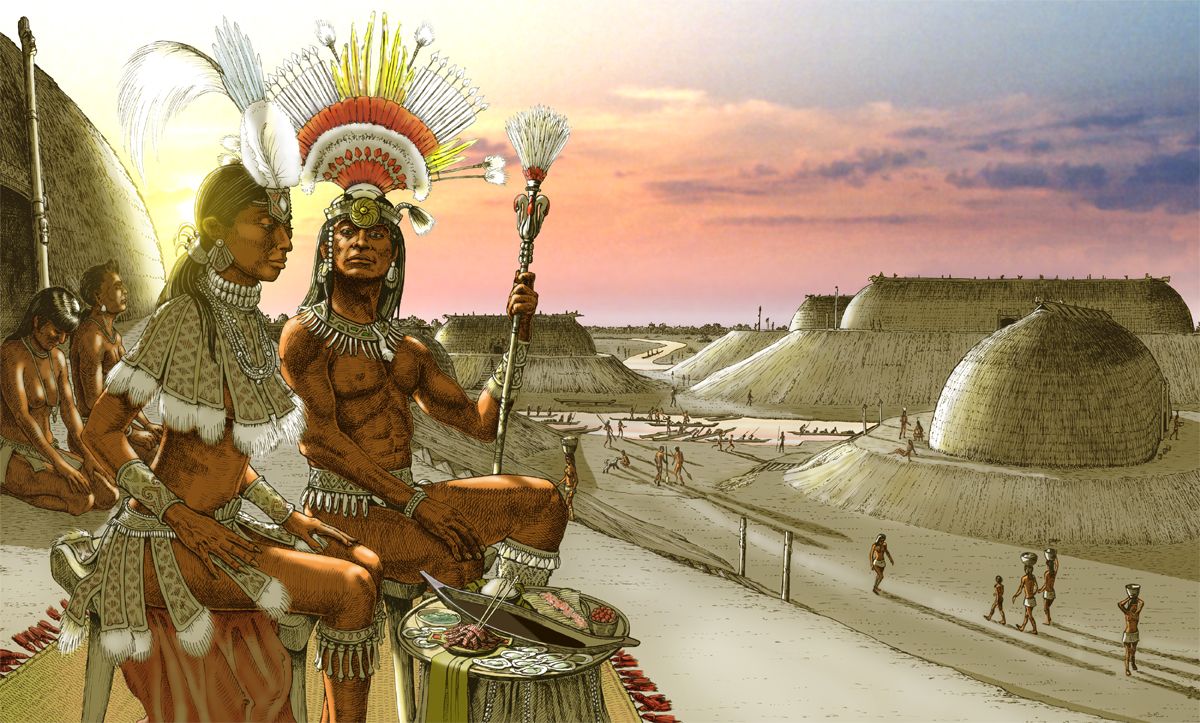
The mysterious tribal people known as The Calusa ruled the area between Tampa Bay and Fort Myers for centuries, with their kingdom having existed at least as early as 1150 BC and vestiges of it surviving as late as the 18th century. Mound Key off the coast of Fort Myers, is believed to have been the original site of the Calusa kingdom's capital city of Calos.

Strange as it may sound, Mound Key is actually a mostly artificial island, created from the Calusa tribe's garbage (oyster shells, fish heads, animal bones, broken and discarded pottery) over the course of centuries. Some have noted that the placement of the waste materials seems deliberate, as if the whole thing was treated like an art project of sorts, with what has been described as "mounds, water courts, and canals".

Once the Spanish arrived, it was all over for the Calusa. In 1566, a bunch of Spaniards showed up and soon built a fort and settlement, and well, there went the neighborhood. A Jesuit mission was founded nearby, called San Antonio de Carlos, and they focused their efforts on converting the Calusa to Christianity. And as you can probably guess, that didn't go over too well. The Calusa had their own religion going on, which was rather complicated according to Wikipedia:

The Calusa believed that three supernatural people ruled the world, that people had three souls, and that souls migrated to animals after death. The most powerful ruler governed the physical world, the second most powerful ruled human governments, and the last helped in wars, choosing which side would win. The Calusa believed that the three souls were the pupil of a person's eye, his shadow, and his reflection. The soul in the eye's pupil stayed with the body after death, and the Calusa would consult with that soul at the graveside. The other two souls left the body after death and entered into an animal.

Calusa ceremonies included processions of priests and singing women. The priests wore carved masks, which were at other times hung on the walls inside a temple. Hernando de Escalante Fontaneda, an early chronicler of the Calusa, described "sorcerers in the shape of the devil, with some horns on their heads," who ran through the town yelling like animals for four months at a time.

The Spanish eventually left and gave up trying to convert the natives, but the damage had been done - they'd brought diseases with them for which the Calusa had no natural immunity. The last of the Calusa had vanished by 1750, and for the subsequent century Mound Key was used by pirates, American pioneers (even Daniel Boone and his brother Squire made their way to the Sunshine State at one point) and fishermen (Cuban, Portuguese, Spanish, etc.)

Then in 1894, the followers of a scientific/religious belief system known as Koreshanity arrived in the area. They built a community based on their utopian "Hollow Earth" ideas, during which time they acquired most of the property on Mound Key. In 1908, after the death of their leader, Cyrus "Koresh" Teed, their numbers went into decline. Teed was buried on nearby Estero Island and posthumously became the subject of another controversy when stories began to circulate that anyone approaching or touching his tomb met with bad luck, death, or insanity. Teed's tomb, along with his body, was swept away in a hurricane in 1910.

In 1961, the few remaining Koreshans decided to give up and donate the island, as well as other land in the nearby town of Estero, to the state of Florida. It was used to form a park, which is administered by the Koreshan State Historic Site. Because of this, the Koreshan sect are more famous today than ever - and yet few have ever heard of the Calusa civilization, who created the island in the first place.

Readers of my Unusual Kentucky blog may recall that Cyrus Teed and his Koreshans turn up in the strange case of the wandering occultist-opportunist Editha Salomon, aka Anna Sprengel, aka Ann O'Delia Dis Debar, Laura Horos, Ellora, Madame Helana, Swami Viva Ananda, Della Ann O'Sullivan, Angel Anna, Claudia D'Arvie, Editha Gilbert Montez, Vera Ava, Blanche Solomons, etc.

Saturday, July 20, 2013

The Don CeSar Hotel

I have a thing for fine hotels. Honestly, in this day and age, I don't know why more people don't live in them.

I mean, you get to live in luxury, have fresh sheets and towels brought to you regularly by a maid who comes in and vacuums and cleans your room. Depending on where you stay, there's free breakfasts, there's fine room-service dinners they'll bring right up to your door, there's guys to carry your luggage up and down, there's guys who'll go park your car for you, there's security guards and receptionists at the front desk who'll receive/deliver messages for you and give you wake-up calls, etc.

Most of all, there's efficiency and simplicity, and that's something we all need in spades.

I know, I know, you're saying, "Dude, I can't afford to live in a hotel," but how you livin' now? When you live in a hotel you're paying no electric bill, no water bill, no sewer bill, no gas bill, no cable bill, no internet bill, no phone bill (unless you're stuck in a smartphone plan - sucker!) and you don't have to pay out to the plumber, the roofer, the yard man, the pool guy, etc.

This, then, is why I could easily see retiring someday in the antiquated confines of the old Don CeSar Hotel (aka "The Pink Palace") in south St. Pete's Beach, just a stone's throw from Pass-a-Grille. Rare is the visit to Florida where I don't pop in here for a spell to feed my muse and commisserate with the ghosts of the past.

A fella named Thomas Rowe had a dream of building a Moorish-looking pink castle, and it being the days when someone could just think something up and do it, he did it. Work began in 1924 and it was completed in late 1927, with the official grand opening gala held on January 16, 1928. In the years since, everyone from Presidents to gangsters have slept here - Franklin D. Roosevelt, Bill Clinton, Clarence Darrow, Al Capone, and F. Scott Fitzgerald, who always knew the best hotels to haunt (he and Capone both adored Louisville's Seelbach Hotel.)

Rowe dubbed his dream domicile after Don César de Bazan, the hero in the opera Maritana. The restaurant at the resort is also named Maritana, so evidently Rowe was seriously into this opera. Remind me to check it out (or better yet, put it on myself sometime.)

So who the heck was Don César de Bazan? As a character, he first appeared in the Victor Hugo play Ruy Blas in 1838. For some reason, this side character became the star of a play titled Don César de Bazan by Adolphe d'Ennery and in a different production (also called Don César de Bazan) by Jules Massenet. And finally, from that opera came another, grander one called Maritana which then became the standard-bearer for the Don Cesar story. But why all this fixation about this Don Cesar guy? Was he a real person? How did this side-character from a failed Victor Hugo play end up having such a lasting reverberation through the 19th and early 20th centuries? It's like if a whole theatrical cult of Mercutio had splintered off into a life of its own - which maybe, some say, Shakespeare in fact set into motion by pinching him from The Tragical History of Romeus and Juliet.

And why does the hotel spell it "Don CeSar" instead of "Don César"? I dunno. I don't ask questions. I just smile and sip my tea.

When I stay here, I always think I'm going to get a lot of writing done on whatever novel I'm working on at the moment. That's usually not what happens. Instead, I drink lots of rum and stare at the sea oats waving by the ocean and hear little voices whispering in my ears with new ideas for other stuff I should write instead. Oh well. Whatever works.

Friday, July 19, 2013

DeSoto National Memorial Park

For those who genuflect at the altar of political correctness (and if you haven't guessed already, I'm not one of those), it's kind of tricky to have a national monument devoted to a guy who was essentially a marauding pirate determined to leave his mark on the world, but the website for the DeSoto National Memorial gives it a pretty good go:

In May 1539, Conquistador Hernando de Soto’s army of soldiers, hired mercenaries, craftsmen and clergy made landfall in Tampa Bay. They were met with fierce resistance of indigenous people protecting their homelands. De Soto’s quest for glory and gold would be a four year, four thousand mile odyssey of intrigue, warfare, disease, and discovery that would form the history of the United States.

De Soto sailed to the New World in 1514, arriving to kick ass and chew bubblegum - and he had no gum. He quickly set about organizing that which was there to be organized, in the manner he saw fit, and soon came to prominence with his trademark scheme to kidnap the chiefs of native villages and then extort the villagers for their safe return. He did make some historically noteworthy achievements - he led the first European expedition deep into the territory of the modern-day United States and was the first European documented to have crossed the Mississippi River - but he was notorious around the world for his brutality.

The De Soto National Memorial in Bradenton marks what is believed to be the location of Espiritu Santo, the point of disembarkation for DeSoto's expedition. In May 1539, Hernando de Soto and an army of over 600 soldiers mounted their campaign here, executing the order of King Charles V to sail to La Florida and "conquer, populate, and pacify" the land.

Most of the Florida sites on DeSoto's trail have been built over, but in recent decades two have been documented as definitively associated with de Soto's expedition: the Governor Martin Site (at the former Apalachee village of Anhaica in Tallahassee) in 1986 and the White Ranch Site (in the Potano territory just outside Ocala) in 2005.

But even without all the historical considerations, DeSoto National Memorial in Bradenton is a beautiful park, relatively free of crowds, and provides yet another opportunity to "get away from it all" in the hustle of bustle of wacky, wonderful Florida. But watch out for the crazy creatively-anachronistic gang from Camp Uzita, a living history camp that runs from December through April, and who put on a yearly in-costume re-enactment of DeSoto's landing on the beaches of Tampa Bay.