Showing posts with label religion. Show all posts

Thursday, May 15, 2014

Zombie Palm

Zombia antillarum, commonly known as the "zombie palm", was originally native to Haiti and the Dominican Republic but is catching on in Florida. Its name is related to the Haitian zombie concept but linguists and ethnographers aren't fully certain how. According to Wikipedia, researchers Fabienne Boncy Taylor and Joel C. Timyan studied the zombie connection to Zombia antillarum and found:

Oil extracted from the seeds has been described as a "sense-activator" by one ethnographic source and can be used to "awaken" a zombie, and that a dwelling with thatch made from the leaves of the plant could prevent zombies from being used to spy on its occupants.

Charles Reynolds, a Winter Haven horticulturist, says in the Lakeland Ledger, October 18, 2002, that "Zombie palms are said to hold near-sacred status with some individuals" and states that the sharp wooden spines of the tree are often used for voodoo dolls.

Wednesday, April 30, 2014

The Door Into Summer

For some, April 30 means Walpurgis Night (Walpurgisnacht). It's a traditional religious holiday of pre-Christian origin, celebrated by Christian as well as non-Christian communities, past the stroke of midnight and through "The Door Into Summer", also known as "May Day". It's probably the one day of the year that Catholics, pagans, witches, Satanists, and anarchists all almost see eye-to-eye. The phrase "The Door Into Summer" also turns up as, of all things, the title of one of my favorite Monkees songs.

Walpurgisnacht is named for Saint Walpurga. The earliest representation of Walpurga, from the early 11th century, depicts her holding stylized stalks of grain. The grain attribute has been interpreted as identifying Walpurga as a Christianized protectress of the grain, the Grain Mother. Farmers fashioned her image in a corn dolly at harvest time, and from this tradition also comes the real origin of the Scarecrow figure in the fields - scaring birds was never its original intention.

Other traditions call this time, midpoint between the vernal equinox and summer solstice, Beltane. And still others - such as the Vikings - called it "The Feast of Valbörg". In ancient Mesopotamia, this orgiastic fertility rite was known as "Zagmuku", while in ancient Egypt, this Spring fertility festival was known as "The Festival of the Joyous Union." According to Janet and Stewart Farrar, in their book Eight Sabbats for Witches, this time has historically been, and I'm quoting here, "a festival of unashamed human sexuality and fertility." This is probably why Anton LaVey chose this date for the founding of his Church of Satan, and possibly why Adolf Hitler chose it as the day he committed suicide (that is, if you believe everything you read in history books and I'm not entirely sure I do.)

I've seen it said elsewhere that May Day customs include walking the boundaries of one's property, repairing fences, and boundary markers, performing chimney sweeps, participating in archery tournaments, dancing, feasting, music, drinking, and indulgence. Hunh. Okay. I dunno about archery and chimneys, but I got those last five items down cold.

"The Door Into Summer" just happens to be the name of a 1956 novel by Robert Heinlein. It's a peculiar story of an engineer and an 11-year-old girl who, thanks to the magic of time travel, end up marrying after jumping around in space and time to a point where their ages match up. Heinlein apparently was unaware of his title's relevance to Beltane, because as he tells the story of its origin, his wife made an offhand comment about the family cat at wintertime "looking for a door into summer." (Did his wife know the real meaning of the phrase? I suspect so.)

Unfortunately, any such calendar date that is fetishized by occult and occult-wannabe types is going to attract bad mojo. I find there's a rather high quotient of unsolved "cold case file" murders and disappearances that took place on April 30/May 1, and especially in Florida.

Stay frosty out there tonight, y'all.

(Illustration above by Stefan Eggeler, for the 1922 edition of Gustav Meyrink's Walpurgisnacht.)

Friday, December 20, 2013

The Chicken Church

This year, the Church By The Sea in Madeira Beach inadvertently gained national fame and became something of an Internet meme.

Basically, because their church looks like a giant cartoon chicken.

As a longtime aficionado of anthropomorphic buildings myself, I love it - but I hear that the people who run the church unfortunately aren't as thrilled about the newfound attention. Come on, people, lighten up. It could have been a lot worse.

Wednesday, August 7, 2013

The Great Cross of St. Augustine

Overlooking Matanzas Bay in St. Augustine, you'll find the Great Cross of St. Augustine - not to be confused with the "Cross of St. Augustine" medal or the stone memorial in Kent, England - marking the site where the city of San Agustin was founded on September 8, 1565 by Pedro Menendez de Aviles, a Spanish admiral. Father Francisco Lopez de Mendoza Grajales, the Spanish fleet's chaplain, performed a Thanksgiving Mass from a primitive altar erected on the shore. (Contrary to everything we were taught in grade school, this is the site of the first introduction of Christianity into America and the site of the first Thanksgiving held in America, not Plymouth Rock and its Mayflower pilgrims.)

The Great Cross was erected in 1965 to coincide with the city of St. Augustine's 400th anniversary, and is designed to theoretically be hurricane-proof.

Sunday, July 21, 2013

Lost City of Calos

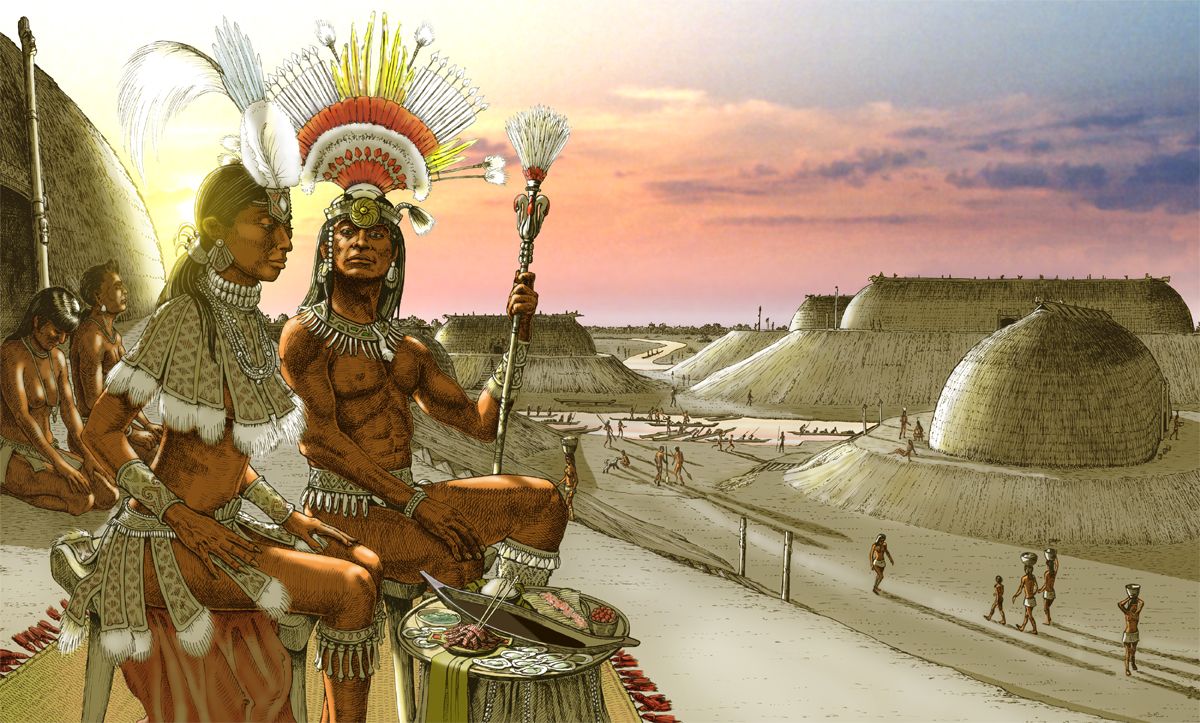
The mysterious tribal people known as The Calusa ruled the area between Tampa Bay and Fort Myers for centuries, with their kingdom having existed at least as early as 1150 BC and vestiges of it surviving as late as the 18th century. Mound Key off the coast of Fort Myers, is believed to have been the original site of the Calusa kingdom's capital city of Calos.

Strange as it may sound, Mound Key is actually a mostly artificial island, created from the Calusa tribe's garbage (oyster shells, fish heads, animal bones, broken and discarded pottery) over the course of centuries. Some have noted that the placement of the waste materials seems deliberate, as if the whole thing was treated like an art project of sorts, with what has been described as "mounds, water courts, and canals".

Once the Spanish arrived, it was all over for the Calusa. In 1566, a bunch of Spaniards showed up and soon built a fort and settlement, and well, there went the neighborhood. A Jesuit mission was founded nearby, called San Antonio de Carlos, and they focused their efforts on converting the Calusa to Christianity. And as you can probably guess, that didn't go over too well. The Calusa had their own religion going on, which was rather complicated according to Wikipedia:

The Calusa believed that three supernatural people ruled the world, that people had three souls, and that souls migrated to animals after death. The most powerful ruler governed the physical world, the second most powerful ruled human governments, and the last helped in wars, choosing which side would win. The Calusa believed that the three souls were the pupil of a person's eye, his shadow, and his reflection. The soul in the eye's pupil stayed with the body after death, and the Calusa would consult with that soul at the graveside. The other two souls left the body after death and entered into an animal.

Calusa ceremonies included processions of priests and singing women. The priests wore carved masks, which were at other times hung on the walls inside a temple. Hernando de Escalante Fontaneda, an early chronicler of the Calusa, described "sorcerers in the shape of the devil, with some horns on their heads," who ran through the town yelling like animals for four months at a time.

The Spanish eventually left and gave up trying to convert the natives, but the damage had been done - they'd brought diseases with them for which the Calusa had no natural immunity. The last of the Calusa had vanished by 1750, and for the subsequent century Mound Key was used by pirates, American pioneers (even Daniel Boone and his brother Squire made their way to the Sunshine State at one point) and fishermen (Cuban, Portuguese, Spanish, etc.)

Then in 1894, the followers of a scientific/religious belief system known as Koreshanity arrived in the area. They built a community based on their utopian "Hollow Earth" ideas, during which time they acquired most of the property on Mound Key. In 1908, after the death of their leader, Cyrus "Koresh" Teed, their numbers went into decline. Teed was buried on nearby Estero Island and posthumously became the subject of another controversy when stories began to circulate that anyone approaching or touching his tomb met with bad luck, death, or insanity. Teed's tomb, along with his body, was swept away in a hurricane in 1910.

In 1961, the few remaining Koreshans decided to give up and donate the island, as well as other land in the nearby town of Estero, to the state of Florida. It was used to form a park, which is administered by the Koreshan State Historic Site. Because of this, the Koreshan sect are more famous today than ever - and yet few have ever heard of the Calusa civilization, who created the island in the first place.

Readers of my Unusual Kentucky blog may recall that Cyrus Teed and his Koreshans turn up in the strange case of the wandering occultist-opportunist Editha Salomon, aka Anna Sprengel, aka Ann O'Delia Dis Debar, Laura Horos, Ellora, Madame Helana, Swami Viva Ananda, Della Ann O'Sullivan, Angel Anna, Claudia D'Arvie, Editha Gilbert Montez, Vera Ava, Blanche Solomons, etc.