Showing posts with label islands. Show all posts

Monday, March 30, 2015

Jupiter Island

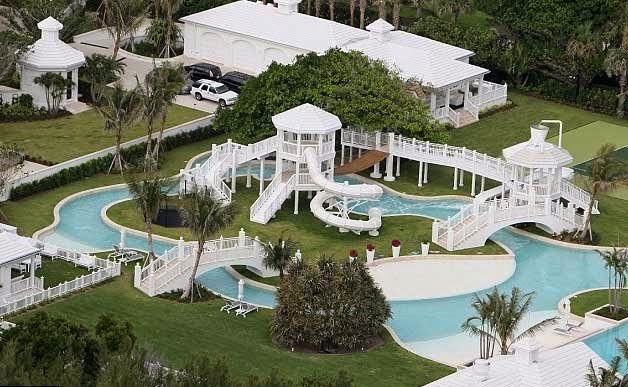
There are many locales in Florida where the celebrities and the super-rich congregate, but perhaps none so gorgeous as Jupiter Island. It's a thin barrier island off the coast of Port St. Lucie, and it's here where you'll find the lavish homes of Celine Dion, Alan Jackson, Lee Trevino and Tiger Woods. (That's Celine's place pictured directly below.)

It's also where you find the amazing Blowing Rocks Beach. It's dotted with beautiful old weathered rock formations, and is now a nature preserve where loggerhead, leatherback, and green sea turtles call their home.

Better break the piggy bank if you want to join this elite crowd - according to Zillow, homes there go for between one million and 45 million dollars.

Tuesday, March 24, 2015

Star Island

One of the most exclusive and coveted places to live in Miami Beach is this lovely little island served by a single causeway, known as Star Island. I'm not sure if the name predates its current status as a refuge for celebrities, but it's well known for being home to such luminaries as Gloria Estefan, Rosie O'Donnell, Don Johnson, Sean Combs and Shaquille O'Neal. However, unscrupulous tour guides and realtors have exaggerated the island's celebrity stories, and have made false claims about Julio Iglesias, Madonna, Sylvester Stallone and Elizabeth Taylor also living here.

Some scenes from the Sylvester Stallone film The Specialist were filmed on Star Island, which may have inspired the myth that he lives there. (Though Stallone did attend the University of Miami, his home is in Beverly Hills, California.)

Tuesday, February 3, 2015

The Estero Bay Islands

Oddly, there's no overarching name for the group of mostly-connected-by-bridges islands off the Gulf Coast in the Ft. Myers/Cape Coral area. You sometimes see the term "The Sanibel Islands" but this is usually in reference to just Sanibel and Captiva. For lack of anything better, we'll call them "The Estero Bay Islands" for now. (Similarly, "The Florida Keys" is a pretty terrible and misleading name for those most famous islands at the state's southern tip, and "The Bayway Islands" isn't a very creative name either.)

Your adventure starts in Bonita Springs, where Bonita Beach Road will take you offshore onto the marvelous Little Hickory Island (which isn't so little), a highly populated, swingin' place, very beachy-restauranty-touristy. Like most of these islands, it's crawling with people, so get out here early if you hope to get a parking place for a beach access spot.

Next up is Bay's Island and Big Hickory Island (plus a bunch more accessible by boat only, like Battista Island). Not a whole lot going on here, though there's a fabulous beach on Big Hickory's northern end. Then the road takes you over a couple of unnamed islands (name those islands, dammit!) which is weird because one of them has one of the region's most beloved dog beaches. I've seen no online source that names the island it's on - they just say "Estero", which is the city that owns these keys.

Long Key is next, and Black Island - which is where you can turn off and drive over to Lovers Key and Inner Key at the Lovers Key State Park. Black Island is a strangely shaped squiggle of land that has tendrils coming off it that almost make it three different islands - and when you're standing on one arm of it looking way over at another, it might as well be so. Other islands, like Charlie Key, Monkey Joe Key, Davis Key, Little Davis Key, and Mound Key loom in the distance, inaccessible by automobile.

Estero Island may not come first to mind - if at all - when you think of party-tourist hotspots in Florida, but let me tell you, this place is hoppin'. After the mangrove nature trails of the last few islands, you may be shocked to find this one completely built up with resorts, beach cottages, and row upon rows of stores and bars. The beaches here are fantastic, and I suspect a lot of people, fed up with trying to find a place to park down the road at Sanibel, just say to heck with it and make camp here. There was a biker event going on when I was recently here, and the place had that quintessential good-times-in-Florida feel.

Meanwhile, inside the bay, plenty more islands lie in wait for your exploration via boat. Most are unnamed, but at least three are: Dog Key, Julie's Island, and Starvation Key.

Beyond Estero Island we find San Carlos Island and a community that is partially built on mainland swamp and partially on artificial islands; the maps list it as Siesta V, and about it I can find very little. You cross over these on your way back to the mainland for just a bit before heading back over the puddle to enter Summerlin Road, which quickly changes its name to McGregor Blvd, and then becomes the Sanibel Causeway.

Once on the causeway, first up is Connie Mack Island, a lovely little boating community mostly surrounded by swampland. Then there's Punta Rassa, an almost-island which for some reason has a much more colorful history than some of its neighbors. It was once a thriving shipping port for cattle, was a key site during both Seminole Indian Wars and the Civil War, and its telegraph office was where America first learned of the sinking of the U.S.S. Maine in Cuba in 1898.

Then we have Island A and Island B, two beautiful must-pull-over spots on the causeway. What they lack in imaginative names, they more than make up for in tranquility. Personally, I'd be happy to stop here and kick back on Islands A and B and call it a night. Estero has all the action one needs and A & B have all the tropical peacefulness. But for many tourists, the real goal is still to come: Sanibel Island.

Sanibel's a weird and rather creepy place. You can never really get a grip on it because it's a mishmash of highly touristy places intermingled with deep jungle-like nature preserves. There are long stretches of civilization followed by even longer spooky swampy stretches of "Where the hell am I?"

The reason Sanibel is so popular is because it's regarded as the ultimate place to collect exotic shells on the beach in Florida, and perhaps the entire nation. This is in part because Sanibel is a geographical oddity: a barrier island that sticks out east-west rather than hugging the coast north-south. For this reason, they say, flotsam and jetsam from the sea are more likely to wash up here than elsewhere.

But there's even one more island drivable past Sanibel: Captiva Island. Artist Robert Rauschenberg made Captiva his home and workplace, and his studio still stands today, just as he left it when he died. His estate remains the largest landowner in the area. The photo below was taken at the Green Flash Dock in Captiva, overlooking Buck Key in the distance.

North Captiva Island is not connected to Captiva Island by road, but is home to many rich folks who go get their groceries by plane or boat.

If you're lucky enough to have said boat, there's still loads more islands past North Captiva that properly belong classified with this grouping before you reach the huge mouth of Charlotte Harbor. To name just a few: Lacosta Island, Punta Blanca, Black Key, Wood Key, Josslyn Island, Cabbage Key, Useppa Island, The Panther Keys, Bokeelia Island, Patricio Island, Burgess Island, etc.

And don't forget Pine Island, a massive one that runs parallel to much of Sanibel and Captiva, and is accessible by car from the mainland but it's a very long drive to get back up and around to its entrance. So much so, that it's probably something you'd do on a different day's excursion. But if you go, bring your metal detector.

Me, I just wanna go back to Island A.

Tuesday, January 6, 2015

Atsena Otie Key

Off of Florida's Nature Coast, near Cedar Key, you'll find Atsena Otie Key, a charming little island whose claim to fame - as far as I'm concerned anyhow - is having been mentioned in Kurt Weill and Bertolt Brecht's Rise and Fall of the City of Mahagonny. (Historically speaking, it was also instrumental in the first and second Seminole Wars, in the Civil War "Battle of Cedar Key" and the taking of the USS Somerset, but, well, we each have our frames of reference.)

Though its heyday is over (it once was home to a thriving community), the 'ghost town' remains of the settlement linger on - along with a fishing pier, toilet facilities, and a walking trail to a 19th century cemetery.

Sunday, December 28, 2014

Marco Island

Just past Naples, you take a short drive south through the outer edges of the Everglades, and suddenly find an oasis of civilization amid the swamps - Marco Island. Though it's much-ballyhooed for its shopping experience, I don't find it to be nearly as special as the over-the-top shopping island St. Armand's Key off the coast of Sarasota. Marco's pretty much, as far as I gleaned, just another bunch of high-rise condos and pizza joints with retirees shuffling around carrying towels and pool noodles as they walk their terriers.

What I like best about the island is Caxambas Park at the very bottom, where you finally reach the end of the line unless you have a boat in tow and I didn't.

Here, you overlook the beginnings of the Ten Thousand Islands, a seemingly endless labyrinth of isles (there aren't quite ten thousand of them, but it seems that way sometimes!) where innumerable adventures of piracy and exploration took place in distant points on the track of time.

Saturday, November 15, 2014

Naples Island

So, there's this island I cross over every day to get into downtown Naples, and wondering what it was called, I consulted the maps online. I found nothing.

As you may know, I cannot abide unnamed islands.

But as luck would have it, by searching for information on the condos located there, I find that their websites state they're "situated on Naples Island just a few blocks from downtown Olde Naples". So there you have it.

Whew. I can relax now.

Friday, November 7, 2014

Big and Little Talbot Islands

Little Talbot Island can be found 17 miles northeast of Jacksonville, on the A1A. It's 2,500 acres of state park property, with Big Talbot Island and Long Island nearby. Despite the nomenclature, Little Talbot Island is actually larger than Big Talbot Island due to erosion and nature's shifting whims of sand deposition.

Despite its rustic swamp-beach island appearance, amenities include a full–facility campground, beachside picnic pavilions, bath houses, boat ramps, nature trails, a playground for children, and a rental facility for bicycles, canoes, and other gear.

Big Talbot and Little Talbot are two of only a handful of barrier islands that still remain undeveloped in Florida. The Native American Timucua tribe were, so ethnologists say, the first humans to inhabit these islands. When the French arrived here in 1562, these islands were claimed as colonial territory. However, England and Spain claimed the islands as well, and in 1735, General James Oglethorpe named the Talbot Islands in honor of Charles Talbot, Lord High Chancellor of England. (I'm still trying to find out what the Timucua called them, and suggest we think about renaming them back to that.)

Monday, September 22, 2014

Orchid Island

The Survivors and Salvagers Camp is a historic site located on Orchid Island. It was here that survivors of the 1715 Spanish Treasure Fleet disaster washed up ashore, and established a camp while awaiting rescue. Subsequently, Orchid Island was also used by salvagers and sunken treasure seekers, attempting recovery of the 1715 fleet's gold. Currently, the McLarty Treasure Museum occupies part of the area.

The McLarty Treasure Museum (note: that's a pdf file) is located here today, and has many examples of the 1715 fleet's treasure and other artifacts on display.

Orchid Island and North Hutchinson Island are actually the same island, but for reasons foggy with the mists of time the island has different official names in different counties. Technically, by the book, the St. Lucie County part of it is called North Hutchinson Island and the Indian River County portion is called Orchid Island. However, nowadays, virtually everyone everywhere refers to it as Orchid Island.

Friday, August 29, 2014

Islamorada Hurricane Monument

Erected in 1937, this stone crypt on the island of Islamorada contains the cremated remains of over 300 victims of the 1935 Labor Day hurricane that devastated the area with 185-200+ mile winds, a 15-foot flood, and the lowest barometric sea level pressure ever recorded in U.S. history.

Some wags have criticized that the image on the monument is wrong, because it depicts palm trees being blown away from the storm. Looking at it, I'm not really sure how they deduce that. But even so, palm trees can whip in a circular motion during a hurricane, so stop ya whinin'.

Thursday, August 28, 2014

Grave of B.P. Roberts

Betty Pearl Roberts used an old joke from Mad magazine for the message on her final resting place. At least, I hope the inscription was her idea.

You can find it in Key West Cemetery.

Monday, July 21, 2014

Paradise Island

Paradise Island is another one of those "blink and you'll miss it" causeway islands, appearing on your way out of Pasadena towards Treasure Island. On your way you also pass two other islands called, somewhat unsatisyingly, the South Causeway Isles. (Or, if you prefer, "Yacht Club Estates", which is the name of the gated community that occupies them.)

I've never actually gotten out of the car and walked around here. I don't even know if there are parking places for an uncouth outsider like me anyway. But it's enough to drive around on it, or even just to pass it by quickly on my way to Sunset Beach.

Wednesday, July 16, 2014

Useppa Island

And then there's Useppa Island, a mellow little resort in Pine Island Sound, just north of Captiva Island. It's been, sporadically, a hotel resort since 1896, and declassified documents revealed the CIA used it for secret training of officers for the planned and aborted Bay of Pigs invasion of Cuba in April 1961.

This island's name has a legend about it - another one of those forced, reverse-engineered ones made up years after the fact because humans simply can't abide the vacuum - which states there once was a girl named Useppa who was kidnapped from her home in Havana, Cuba and held prisoner on this island by Gasparilla the Pirate. Supposedly he beheaded her, and of course, this leads to the story that people say that to this very day, you can sometimes still see her headless ghost walking along the beach. That is, if you've had nine Fuzzy Navels on an empty stomach.

The same story, by the way, is the basis for the folk-etymology name for Captiva Island, where Gaspar is said to have kept scores of women held captive for ransom and such. This guy must have had women stashed on every island. And it doesn't help the believability factor when you realize the exact same stories are told about another pirate, Black Caesar.

The real origin of the island's name is most likely a series of misheards going back to when it was referred to as Josefa Island in an 1838 document. From there, the name got mangled into "Giuseppe Island" on an 1870 census and "Useppi" in 1875, finally arriving at the spelling of "Useppa" as so called by the Smithsonian Institution in 1882.

Then again, some have suggested the original "Josefa" name comes from the princess daughter of Martín de Mayorga, Viceroy of New Spain from 1779 to 1782, and that she was indeed killed on this island. This almost lends some credence to the Gasparilla story... except it doesn't. And there's still another haunting legend on Useppa Island, one that says reported sightings of the ghosts of the Calusa Tribe are common. How some tourist from Nova Scotia would know what a Calusa looks like, I don't know. But they did encamp on the island in antiquity. So there.

But never mind all that. Useppa Island is a lovely place for a getaway, with luxurious lodging and dining for those who want to get away from it all a little further than Captiva.

Sunday, July 6, 2014

Beyond Key West

Key West is frequently spoken of as being the last of the Florida Keys, referred to even by native Floridians as "Land's End". A year ago today on this blog, we also examined the sketchiness of the "Southernmost point in the United States" claim, and now we see what lies beyond.

The Keys extend a great distance in a westerly direction past Key West, which is really only the end of the drivable Keys. For those among you with boats (and courage to navigate the treacherous reefs) there's a whole 'nother world way out there.

Wisteria Island, Sunset Key and Frankfort Bank are all wester than Key West, and there's actually a lot of hubbub on Sunset Key. Accessible only by boat, it's covered in luxurious homes of the wealthy and westerly.

Beyond that, there's a vast expanse of ever-shifting sandbanks, reefs and islands, so obscure that FlashEarth (which usually excels at island nomenclature) doesn't even list their names.

First is Mule Key. A lovely little secluded spot, but don't get your hopes up for partying on it because Coast Guard/Park Ranger types live here. Keep moving.

Next is Archer Key, Joe Ingram Key, and the Barracouta Keys. Joe Ingram Key was named after former U.S. Coast Guard Petty Officer Joseph Ingram after the 2004 midnight rescue of four fisherman adrift south of the key. That's all well and good, but I don't approve of such revisionism. The previous name for the island was "Key B", which, frankly, also sucks. Going even further back, we find that Key B and several other of these islands nearby were alternately known as Cayos Mulas, Cayos de Chequimula, the Mangrove Islands or the Crawfish Islands, depending on who you asked. A number of these islands once had names like Bluff Kay, Crawfish Kay, Double Key, Saragold Key and Cotterels Key, and are listed as such on old maps, but are not recognized today. According to The Key Names Gazeteer, "The place-name history of these keys is extremely convoluted and confusing. Names of keys have frequently been interchanged, changed, and generally jumbled over the years."

There are distinctly five islands which our current cartographers choose, insanely, to blanketly label as Man Key, and not even "The Man Keys". There's also a sixth one just north of them, and apparently nobody has a name for that one. Eventually I will publish an exhaustive online indexification of all Florida islands and their original nomenclature - something that, believe it or not, still literally does not exist in the year 2014 - and when I do, I'm gonna go all the way back to what the pirates and indians said, and reduce the goofy modern monickers to the asterisk, not the other way around.

Also to the north, there's Cottrell Key, Big Mullet Key and Little Mullet Key - not to be confused, obviously, with the more well-known Mullet Key in the Bayway Islands.

Next up, we find Ballast Key, which, for the billionaires among my readers, is actually for sale. It features the lavish home of eccentric developer David Wolkowsky, and made an appearance in the James Bond film License To Kill. Tennessee Williams spent a lot of time here as Wolkowsky's guest in the late 1970s and early 1980s. Ballast Key is another spot that has been, falsely, regarded as the last island and furthest point of the United States. But steer your rudder further on and you'll see that it ain't necessarily so. Woman Key is next, and it's practically swimming distance from Ballast Key.

The huge Boca Grande Key can be found several miles further. Though setting foot on most of these islands I've named so far is technically illegal because it's all "protected lands", many people do anyway - but at least on Boca Grande Key, anchoring is permitted on the northwest portion.

But wait, there's more! Even further out into the scary seas, there's a distant cluster called the Marquesas. Popular with fishermen, the Marquesas are made up of several islands whose names have a confusing history. The northernmost key is the largest and has a strip of sandy beach free of mangrove. In the past it was known as Entrance Key. It surrounds the lagoon in the north and east. Adjoining in the south are smaller keys such as Gull Key, Mooney Harbor Key, and several unnamed keys in the southwest corner of the group. Older charts show that two of these keys once were named Button Island and Round Island.

Is that it? No! Further west is Rebecca Shoal, an almost-island just a few feet below the sea's surface, upon which sits an offshore light station. Reaching it by boat is nearly impossible because of the extremely dangerous abrupt changes in reef level. You'd have to drop anchor in the deep water and send a small speedboat or something out to the station. Even the Coast Guard rarely attempts to approach it. There could be a family of gypsies living up there, and who would know?

37 miles beyond that - and now past the limit of the fuel capacity for most small boats leaving Key West - there's the Dry Tortugas. Most of their islands are little more than sandbars, and are constantly changing with the weather, disappearing, reappearing, reconfiguring their shapes. But the more stable islands here are Loggerhead Key, Garden Key, Bush Key, Long Key, Middle Key, East Key and Hospital Key. It's on Garden Key where you'll find what is possibly the weirdest thing in all of Florida - Fort Jefferson, a jaw-droppingly huge hexagonal building that is the largest masonry structure on this hemisphere of the planet. It's composed of over 16 million bricks and was 30 years in the making (beginning in 1846.) At its peak of military use during the Civil War, as many as 2000 people lived and worked here. Today, it's a national park and is open to the public, which is pretty hilarious since it is literally the most remote point in the United States unless you wanna talk about Alaska and I don't.

And technically, there's still just a little more to explore. Even beyond the Dry Tortugas, there's Tortugas Bank, Little Bank and 8 Fathom Bank, which were once islands but are currently submerged. But they could come back at any moment. Life moves pretty fast in Interzone.