Thursday, August 15, 2013

Noisy Clouds

Just another afternoon in Interzone:

On February 3, 1969, people on Jacksonville Beach began hearing strange rattling sounds coming from the sky. They gradually realized, so the story is told, that the sound was specifically emanating from two clouds passing directly overhead.

A newspaper article quoted an eye(ear?)witness as describing the sound to be "like constant crumpling of cellophane." Another described it as like the noise of someone "walking on pebbles," only magnified. There were no unusual weather conditions, nor any other reason for the sounds, try as the authorities did to find an explanation for the rattling clouds. A police captain followed one of the weird clouds for a short time until it abruptly dissipated and vanished.

And then a week later, it happened again - this time in Miami Beach.

Of course, an "official explanation" just had to be cobbled together, as it always does, no matter how preposterous. It was decided, by those who decide such things, that all these people, including a police officer, simply mistook the sound of the surf reflecting off the clouds (vapor is not especially noted for its sound-reflective properties) due to "some kind of temporary inversion of sound." As Will Smith once said to Tommy Lee Jones, "...and that weak-ass story is the best you can come up with?"

So..... what the heck was going on here? Ours is not to question. Drink up.

Wednesday, August 14, 2013

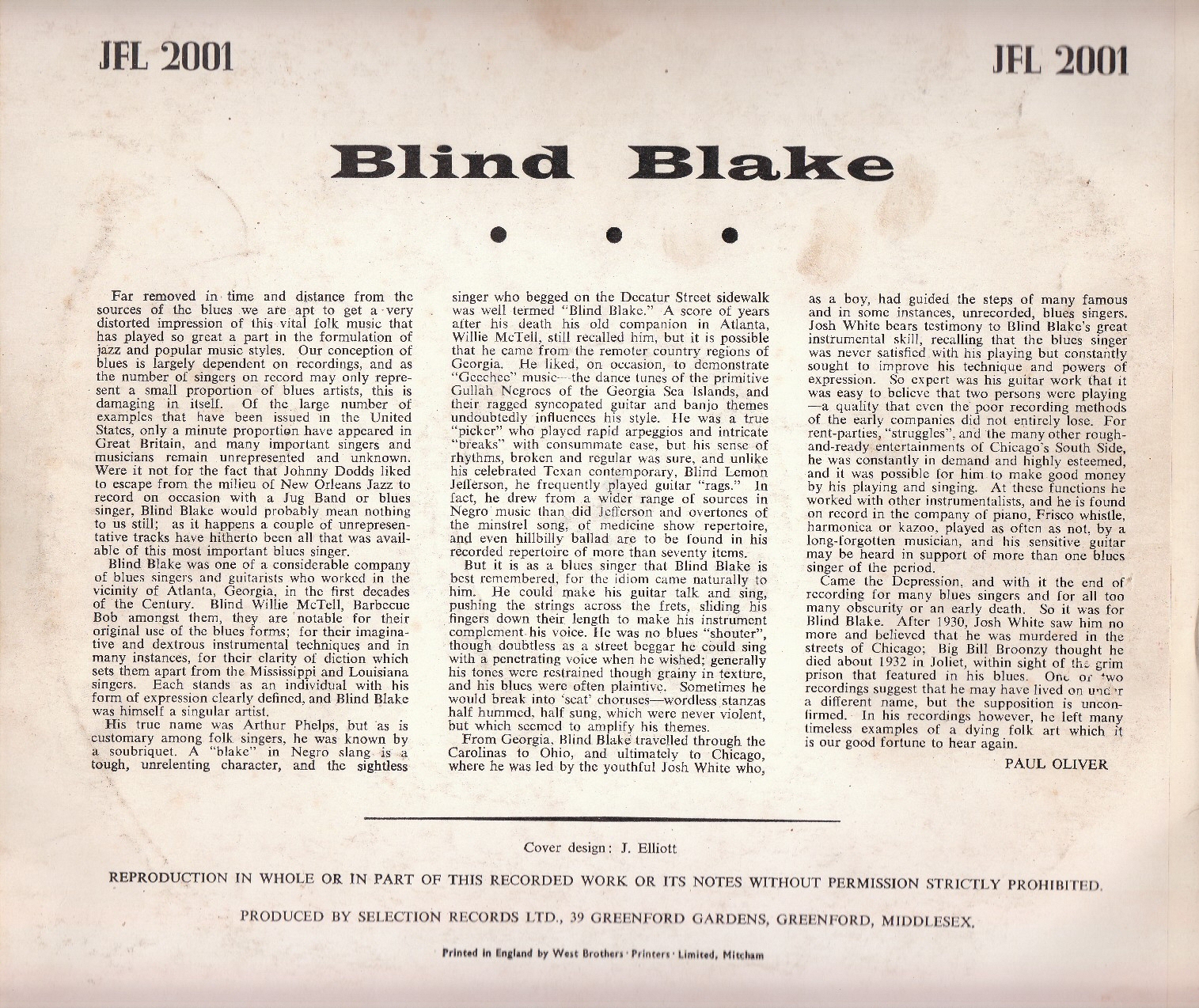
Blind Blake

One of my very favorite pre-war Blues musicians is Blind Blake, who recorded 70-some sides for Paramount circa 1926-1932. You may or may not be peripherally aware of him as part of the background story in Lee Child's Killing Floor, the first of the Jack Reacher novels.

I first got introduced to his music when I lived briefly in New Orleans and went on a spree immersing myself in the works of Blake, Blind Willie McTell, Robert Johnson, Skip James, Charlie Patton, Barbecue Bob, Henry Thomas, Scrapper Blackwell, Sam Collins, Kokomo Arnold, Peg Leg Howell, Blind Boy Fuller, Son House, Furry Lewis, Washboard Sam, Tampa Red, The Hokum Boys, Memphis Jug Band, Frank Stokes, Georgia Tom Dorsey, Black Ace, Papa Charlie Jackson, Sleepy John Estes, Peetie Wheatstraw, Josh White, Robert Nighthawk, etc. Many of his songs including Hastings Street, Come On Boys Let's Do That Messin' Around, Diddie Wa Diddie, and He's In The Jailhouse Now were a huge influence on me during my own roving "lost years" as a street-busking "Creeps Music" songster.

But of all the obscure and unknown blues musicians out there, of whom we know so very little, it never ceases to amaze me how little we know about Blind Blake, who was a successful recording artist in his day. But there's scarcely even convincing evidence that Blake even existed, at least as he was presented. Only one photograph is known to exist of Blind Blake, seen in a Paramount Records catalog with an obviously fraudulent signature.

According to William Barlow's book Looking Up at Down, Blind Blake's real name was Arthur Blake, and he was born in Jacksonville, Florida. As part of the odd spate of blind blues singers during this period in American history, he traveled widely in the south by himself, performing his music. Reportedly he moved to Chicago in the late 20s, where his apartment was said to be a popular hangout for many of the city's legendary bluesmen. In 1932, reports Barlow, Blind Blake joined a travelling minstrel show - and then vanished, never to be heard from again.

This is all complicated by reports of a few sources (including Blind Willie McTell, who knew Blake personally) that his real name was actually Arthur Phelps - but on the record "Papa Charlie Jackson and Blind Blake Talk About It", Jackson directly asks Blake his real name and Blake replies, "my right name is Arthur Blake." More complicated still, a 1934 death certificate from the Milwaukee, WI area lists Newport News as his 1896 birthplace, not Jacksonville, Florida. My own theory is that perhaps Blake attended the Florida School for the Deaf and Blind in St. Augustine and may have lived in nearby Jacksonville for a time. The Paramount Records biographers, not known for their attention to exacting detail, may have confused Blake's having been "from Jacksonville" in his youth with specifically being born there.

And is the grave under the name Arthur Blake in Glendale, Wisconsin (Evergreen Cemetery/Glen Oaks Cemetery), grave #72, Range #115, really Blind Blake? I'm not really seeing a chain of evidence, aside from the identical name and the fact that that death certificate lists his occupation as "artist/musician". And what was he doing in Wisconsin anyway, married to a woman named Beatrice? Some theorize that Paramount Records was hosting him, but Paramount had already gone out of business by that time.

As if these issues don't muddy the waters enough, there's two, maybe three other people who used the Blind Blake name - one was white jazz guitarist Eddie Lang who was credited as "Blind Blake" on some sides. Another was Alphonso "Blind Blake" Higgs was one of the most popular musicians in The Bahamas in the 1950s, leading the house band at the Royal Victoria Hotel. Why he chose to use the "Blind Blake" name is unclear. Thirdly, Stefan Grossman and Gayle Dean Wardlow have suggested that Blake's final record, "Champagne Charlie is my Name", is not even really Blake but some imposter.

Even if Blake wasn't actually born in Florida, we are pretty sure he passed through these parts anyway, evidenced by references to it in songs like "Tampa Bound".

Monday, August 12, 2013

Andrew Jackson Manhole Cover

Is this not the best manhole cover ever? I thought so when I saw it. I wondered why Jacksonville's sewer manhole covers depicted a cowboy waving his hat, and as it turns out, it's actually the city's official insignia and the dude on the horse is none other than President Andrew Jackson, this fair city's namesake.

There's a very famous statue of Jackson and his horsie in this Roy Rogers position in Washington DC's Lafayette Square. There's also a duplicate in downtown Jacksonville but I haven't seen it (I tend to avoid downtown Jacksonville, preferring the laidback vibe of San Marco.)

Jean Baptiste Coudroy de Lauréal

Couple days ago I was meandering around the graveyard at St. Augustine's Mission Nombre de Dios (you know, where The Great Cross is) and wondering about just who these people were and how came they here. Selecting one at random, I decided to do some research on this here Jean Baptiste Coudroy de Lauréal fellow.

Surprisingly, there's very little out there to be found. The most information to be gleaned about ol' J.B. comes from a page not about his grave, but his wife's:

Madame Augustine de Laureal, for many years a resident of Carondelet [Missouri], and related to some of the best known French families of that part of the city, died Monday evening at the residence of her niece, Mrs. Macklot Thompson. The deceased was the widow of J. B. Coudroy de Laureal, a wealthy South American planter who settled in Carondelet in 1848. Mons de Laureal and his family were driven from their vast estates, near Trinidad by an uprising of slaves, and came here stripped of almost all their wealth. Mme. de Laureal was greatly esteemed, and her piety and unostentatious charity endeared her to many. The funeral will take place this morning from the residence of Mrs. Mackot Thompson, third and Kansas streets.

(Curiously, my novel The Seventeenth Island also deals, tangentially, with a tropical plantation overthrown by an uprising of its slaves. Life imitates art imitates bread imitates butter imitates toast and jam.)

Sounds like the de Lauréal folks led an interesting life, but what I still don't know is how he ended up buried in St. Augustine if he and his Haitian wife (whose grave is shown at right) were living out their twilight years in Missouri.

Apparently he authored a medical text, Some Considerations on the Vertebral Disease in Children, which may mean he was a scientist or a doctor, but back then in those freewheeling days, that's not necessarily a given. Maybe he was a self-styled physician (there's a lot of those in Interzone), or just one day woke up and decided to declare himself a spinal expert.

Sunday, August 11, 2013

Phillips-Craig Swamp Cemetery

While on a morning coffee cruise just as the sun was coming up today, this graveyard caught my eye.

The Phillips-Craig Swamp Cemetery near the corner of St. Augustine Road and Lorimier Road, according to the historical sign, contains many of the denizens of the old "Phillips Settlement" - some of South Jacksonville's earliest pioneers - which originally occupied what is now a bunch of subdivisions and run-down business buildings along St. Augustine Road.

The sign says there are at least 135 marked graves documented here; I found this page which lists 95 of them.

The sign on the front gates spells it "Phillips" but the historical marker says "Philips". I dunno. I'm just a tourist with a typewriter.

Saturday, August 10, 2013

Cigar-smoking Lion

I did a double-take the first time I saw these lion statues around the fountain in Columbia Restaurant's courtyard, St. Augustine. Looks for all the world like he's smoking a cigar, but it's actually a pipe from which water sprays into the fountain. I've never actually seen it running, though. (Does it ever run? Is it broken? Can you hurry and fix it please? Because it's awesome?)

Thursday, August 8, 2013

Gasparilla the Pirate

The legend is often told in history books: Jose Gaspar was born in Spain in 1766 and served in the Spanish Navy aboard the ship Floridablanca. Supposedly he became a high-ranking advisor to King Charles III, but had to flee after he was falsely accused of stealing the crown jewels. Vowing revenge on his country and on mankind in general, he renamed himself Gasparilla the Pirate and terrorized the coast of Spanish Florida for the next 38 years. Purportedly his headquarters was on Gasparilla Island, and he kept women as concubines on Captiva Island.

In 1821, that fateful year Spain sold Florida to the United States, Gasparilla considered retiring from his pirate ways but was tempted to have one last adventure in plundering a British merchant ship. That ship, however, turned out to be the American pirate-hunting schooner, the USS Enterprise - which overtook Gasparilla's ship and disabled it in short time. Refusing to surrender, Gaspar attached himself to the anchor and jumped, shouting "Gasparilla dies by his own hand, not the enemy's!"

Problem is, despite this story having made it to scholarly journals, it's uncertain today whether there's a lick of truth to any of it. There's no verifiable record of Gaspar having actually existed, with the first known mention of him being in a railroad company advertising brochure circa 1900. A young pirate who supposedly witnessed Gasparilla's suicide was one Juan Gomez (note same initials) who claimed to be the world's oldest man and regaled impressionable Florida tourists with specious tales of his pirate days in the 19th century.

None of this stops the Gasparilla Pirate Festival from taking place every year in Tampa, however. Nor should it. If Gasparilla wasn't real before, he most certainly is now, manitous and thoughtforms being what they are.

The festival is less about historical accuracy than a damn good excuse to dress up in pirate gear and drink mead. It's become something on a par with Mardi Gras in New Orleans, with parades, floats, and actual Krewes that plan and plot all year round for the event. And also, of course, scantily-clad folks covered in beads.